


Atmel / Microchip ATmega644PA AVR® 8-Bit-Mikrocontroller
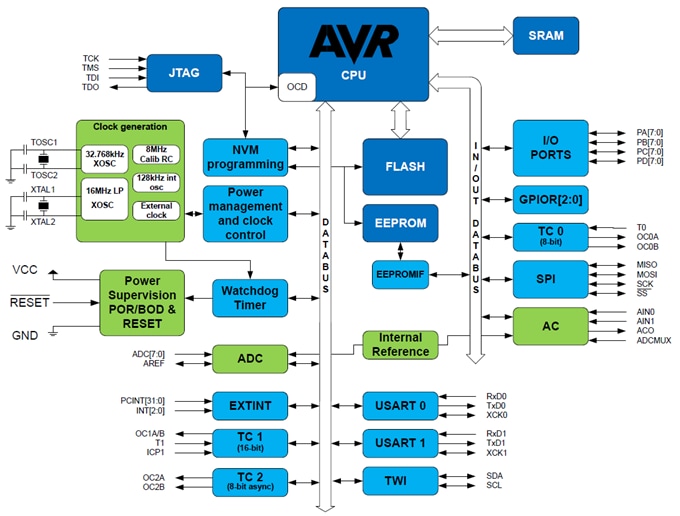
Die stromsparenden ATmega644PA AVR® 8-Bit-CMOS-Mikrocontroller von Microchip basieren auf der AVR®-erweiterten RISC-Architektur. Der ATmega644PA von Atmel ist ein leistungsstarker 8-Bit-Mikrocontroller, der eine hervorragende Flexibilität und kostengünstige Lösung für ein breites Spektrum an integrierten Steuerungsapplikationen bietet. Indem der ATmega644PA bis zu 131 leistungsstarke Befehle pro Taktzyklus verwendet, produziert er einen Datendurchsatz im Bereich von 1 MIPS pro MHz. Mit diesem Prozess kann der Entwickler den ATmega644PA für den Stromverbrauch gegenüber der Verarbeitungsgeschwindigkeit optimieren. Im AVR® -Prozessorkern von Atmel werden 32x8 universelle Arbeitsregister mit umfangreichem Befehlssatz kombiniert. Diese 32 universellen Arbeitsregister sind direkt mit der arithmetischen Logikeinheit (ALU) verbunden. Dadurch wird mit einem Befehl der Zugriff auf zwei unabhängige Register und die Ausführung in einem Taktzyklus ermöglicht, um bis zu zehn Mal schnellere Durchsätze als herkömmliche CISC-Mikrocontroller zu erzielen.
The ATmega644PA produces throughputs close to 1MIPS per MHz, by using up to 131 powerful instructions in a single clock cycle. Using this process, the designer can optimize the ATmega644PA for power consumption versus processing speed. The 32x8 general-purpose working registers with an extensive instruction set are combined in the Atmel AVR® core.
The 32 general-purpose working registers are directly connected to the Arithmetic Logic Unit (ALU). This allows two independent registers to be accessed in a single instruction and executed in one clock cycle to achieve throughputs up to ten times faster than conventional CISC microcontrollers.
Merkmale
- Advanced RISC architecture
- 131 Powerful instructions
- Most single clock cycle execution
- 32 x 8 General purpose working registers
- Fully static operation
- Up to 20MIPS throughput at 20MHz
- On-chip 2-cycle multiplier
- High endurance non-volatile memory segments
- 64KBytes of In-system self-programmable flash program
- Memory
- 2KBytes EEPROM
- 4KBytes Internal SRAM
- Write/Erase cycles: 10,000 Flash/100,000 EEPROM
- Data retention: 20 years at 85°C/100 years at 25°C
- Optional boot code section with independent lock bits
- In-system programming by an on-chip boot program
- True Read-While-Write Operation
- Programming Lock for Software Security
- Atmel QTouch® Library Support
- Capacitive Touch Buttons, Sliders, and Wheels
- QTouch and QMatrix acquisition
- Up to 64 Sense Channels
- JTAG (IEEE std. 1149.1 Compliant) Interface
- Boundary-scan Capabilities According to the JTAG Standard
- Extensive On-chip Debug Support
- Programming of Flash, EEPROM, Fuses, and Lock Bits through the JTAG Interface
- 32 Programmable I/O Lines
- Packages: 40-pin PDIP, 44-lead TQFP, 44-pad VQFN/QFN
- Peripheral
- Two 8-bit Timer/Counters with Separate Prescaler and Compare Mode
- One 16-bit Timer/Counter with Separate Prescaler, Compare Mode, and Capture Mode
- Real-Time Counter with Separate Oscillator
- 6 PWM Channels
- 8-channel 10-bit ADC
- Differential Mode with Selectable Gain at 1×, 10× or 200×
- 1 Byte-oriented 2-wire Serial Interface (Philips I2C compatible)
- 2 Programmable Serial USART
- 1 Master/Slave SPI Serial Interface
- Programmable Watchdog Timer with Separate On-chip Oscillator
- On-chip Analog Comparator
- Interrupt and Wake-up on Pin Change
- Power-on Reset and Programmable Brown-out Detection
- Internal Calibrated RC Oscillator
- External and Internal Interrupt Sources
- 6 Sleep Modes: Idle, ADC Noise Reduction, Power-save, Power-down, Standby, and Extended Standby
- Speed Grades
- 0 - 4MHz @ 1.8V - 5.5V
- 0 - 10MHz @ 2.7V - 5.5V
- 0 - 20MHz @ 4.5 - 5.5V
- Power Consumption at 1MHz, 1.8V, 25°C
- Active Mode: 0.4mA
- Power-down Mode: 0.1μA
- Power-save Mode: 0.6μA (Including 32kHz RTC)
- Operating Voltage: 1.8V to 5.5V
Associated Products
Microchip Technology Ethernet-of-Everything
Schnelle und einfache Vernetzung von "Dingen", die verbunden oder gesteuert werden können.
Block Diagram