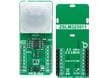

MIKROE-3601

Mikroe
932-MIKROE-3601
MIKROE-3601

Herst.:

Beschreibung:
Entwicklungstools für optische Sensoren Ambient 7 Click

Auf Lager: 1

Lagerbestand:
1 sofort lieferbar
Minimum: 1   Vielfache: 1
Stückpreis:
-,-- €
Erw. Preis:
-,-- €
Vorauss. Zolltarif:

Preis (EUR)

Menge Stückpreis
Erw. Preis
9,46 € 9,46 €

Produktattribut Attributwert Attribut auswählen
Mikroe
Produktkategorie: Entwicklungstools für optische Sensoren
RoHS:  
Add-On Boards
Optical Sensor
SFH 5701 A01
5 V
Marke: Mikroe
Produkt-Typ: Optical Sensor Development Tools
Serie: Ambient
Verpackung ab Werk: 1
Unterkategorie: Development Tools
Handelsname: mikroBUS
Produkte gefunden:
Um ähnliche Produkte anzuzeigen, wählen Sie mindestens ein Kontrollkästchen aus
Um ähnliche Produkte in dieser Kategorie anzuzeigen, wählen Sie mindestens ein Kontrollkästchen oben aus.
Ausgewählte Attribute: 0

CAHTS:
8473302000
USHTS:
8473301180
MXHTS:
8473300401
ECCN:
EAR99

Sensor Click Boards

Mikroe Sensor Click Boards enable the addition of various sensors to applications and designs. Click boards™ are based around the mikroBUS™ interface standard and easily add incredible capabilities to systems. Mikroe Sensor Click Boards are ideal for any application that requires custom sensor capability. 

Click Boards™

MikroElektronika MikroBUS™ Adapter click boards™ are designed to revolutionize the way users add new functionality to development boards. The user can push a click board into the innovative new MikroBUS™ standard socket and use it with zero hardware configuration. Categories of MikroElektronika mikroBUS™ Adapter click boards include Wireless Communication Modules, Wired Communication Modules, Sensor Modules, and Miscellaneous Modules & Accessories.

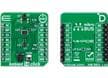
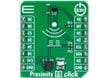
MIKROE-3601 Ambient 7 Click

Mikroe MIKROE-3601 Ambient 7 Click is a light intensity-sensing and measuring board with an accurate light-intensity sensor labeled SFH 5701 A01. The Mikroe sensor is made by Osram Opto Semiconductors and offers high measurement accuracy in a wide range of actual light intensity. The sensor's spectral response is calibrated to match the human eye's spectral response closely. The sensor requires a minimal number of external components thanks to its high level of integration.